The Ukrainian Association of Developers presented a case study of military fortifications
The fortification construction case was first presented during the Ukrainian Construction Award 2025 by DMNTR, an industry event that brought together developers, architects, engineers, and other construction professionals. As part of the program, the Association held a panel discussion entitled "Fortifications as an Engineering Case Study: Architecture, Planning, Solutions" and openly shared its practical experience in the construction of protective structures.
The association raised funds for construction and took on the role of project office, from searching for contractors and analyzing commercial proposals to optimizing costs and engaging specialists to digitize solutions. The key result of this case was the construction of fortifications in the Kharkiv direction with equipped underground shelters and 2 km of communication routes, which are already in use.
As an additional result of their work, the team developed a project solution — a document containing plans and engineering calculations. It is based on practical experience gained directly during the implementation of the project near the combat zone. This software solution can be a useful tool for other units of the Ukrainian Armed Forces as a guideline for planning, designing, and implementing protective structures. That is why the Association of Developers is initiating the dissemination of this experience among the military and the professional community.
.jpg)
An abstract request embodied in a detailed engineering and architectural project
The practical case of the Association of Developers for the Construction of Fortifications in the Kharkiv Region began with a request from the military for professional assistance.
"We received a request for two lines, which specified: 2 km of communication routes, 12 underground fortifications of the UGS. That is, we needed a corrugated steel shelter that had to be buried underground, covered from above, and, accordingly, communication routes between them had to be built. But with a task on half a sheet of paper, it is impossible to provide this," notes Yevgeny Favorov.
In the fourth year of full-scale war, Ukraine faces a paradoxical problem: it has combat experience, but often lacks a systematic engineering approach to building fortifications.
Tetyana Goncharova, moderator of the panel discussion, drew attention on her Facebook page to another problem faced by both civilians and the military. According to her, even with resources available, the lack of clear technical specifications and digitized data complicates the implementation of such initiatives.
"This is a brilliant project in terms of implementation and extremely important. But what surprised me was that specialists are ready to participate in the design and construction free of charge (as I learned, the association has already helped the Armed Forces of Ukraine with billions), but they want to see specific technical tasks. The military is not ready to provide them. There may be typical projects, but given the differences in the landscapes of the regions, there will be no universal denominator here. Meanwhile, the existing fortifications are a fully workable project, but someone has to gather everything that is available and digitize it," Tetyana noted.
Within the scope of the case, the Association raised funds for construction and took on the role of a project office, from searching for contractors and analyzing commercial proposals to optimizing costs and engaging architects to digitize solutions.
"We searched for contractors in Kyiv for a long time, but in the end we worked with contractors from Kharkiv, small companies that were ready to send both people and equipment there," Favorov continued.
The key result was the development of a comprehensive project document—with plans, engineering calculations, layout logic, requirements for waterproofing, ventilation, camouflage, and autonomy of underground structures. The document is based not on theory, but on practical experience gained in close proximity to the combat zone.
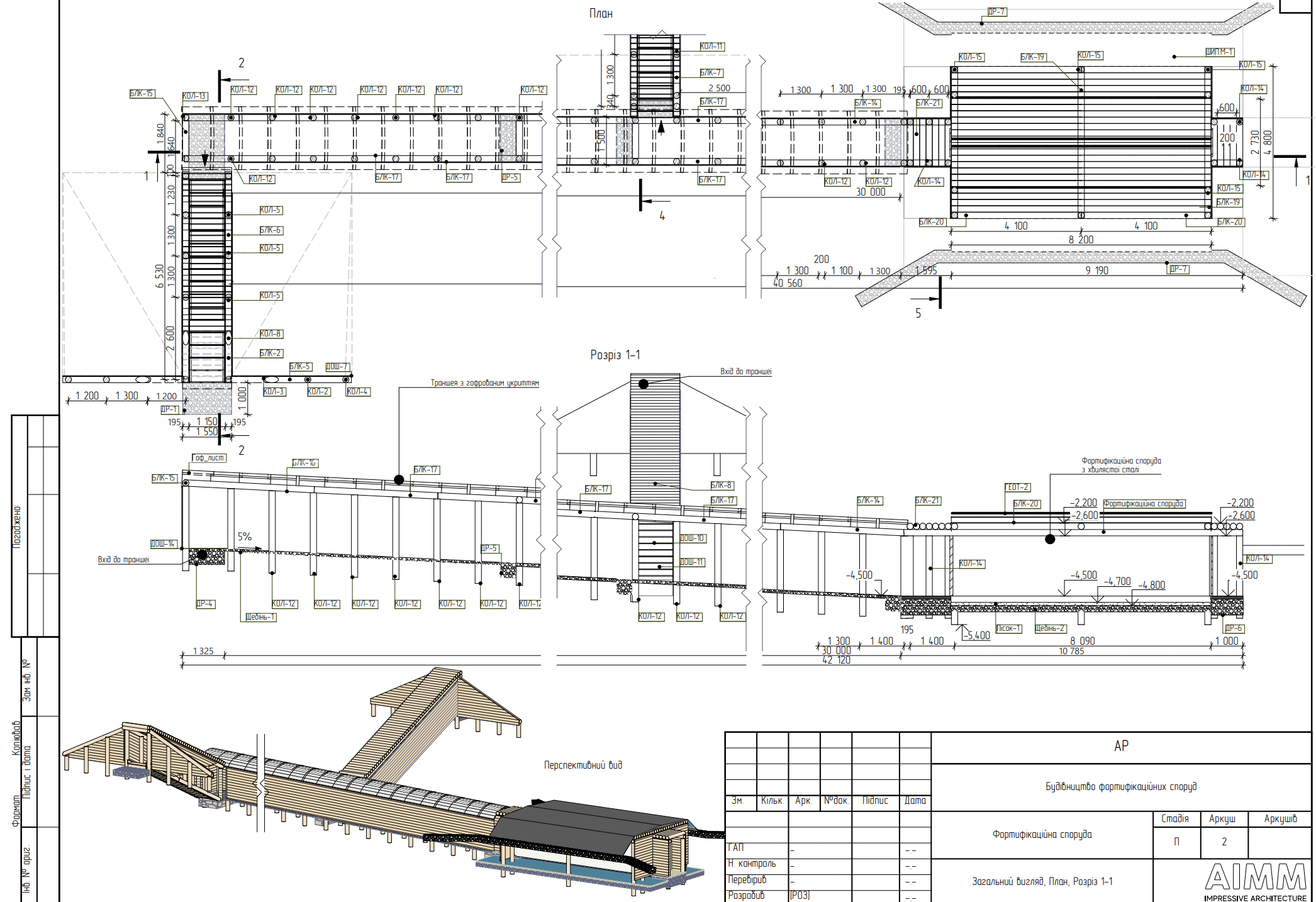
Why the issue of fortifications is critical
During the panel discussion, Andriy Garbuzyuk, acting head of the civil-military cooperation department of the Bureviy Brigade, emphasized that modern warfare has radically changed the requirements for fortifications. The old standards did not take into account either the widespread use of FPV drones or the need for complete autonomy and invisibility.
"If all this knowledge were systematized, formalized in a specific document, and distributed among brigades, engineering, and rear services, it would save many lives, improve combat management, and positively affect the combat capability of brigades," he emphasized.
According to him, teams often have to find solutions on their own, with limited time and resources. That is why civil engineering expertise, adapted to the realities of the front line, can be a critical reinforcement for the Defense Forces.
Yuriy Kryvokhatko, architect and Ukrainian Armed Forces serviceman, added that there is already accumulated experience and standard design tasks have been defined. This has already been partially implemented, in particular on the Delta platform for servicemen.
"But for all this to work out, I would like the military customer to understand who an architect is and how to work with them. Let's think together about how to achieve this," added Yuriy.
From providing resources to transferring knowledge
During the discussion, the panelists separately emphasized the importance of transitioning from one-time assistance to systematic work with engineering expertise. This involves not only resources, but also establishing cooperation between the military, developers, and architects, as well as accumulating and transferring practical experience that can be used by various units of the Ukrainian Armed Forces.
Anna Iskierdo, architect and co-founder of AIMM, the firm that developed the project, said the following:
"We are fully prepared to absorb all the experience of Ukrainian fortifications and create some kind of catalogues, even if they are universal solutions (although I am generally against universal solutions). But it is worth working on establishing a channel of communication between the military, developers, and architects."

The head of the Developers Association, Yevgeny Favorov, noted that this case was a logical continuation of the Association's chosen course on social responsibility.
"In addition to working with the government and protecting the interests of buyers and developers, our Association consciously chose the path of social responsibility last year. We work in various areas, including inclusivity, but our key focus today is the military and providing assistance to military personnel," Favorov emphasized.
The case presented is not a universal "typical project," but it clearly demonstrates the process, logic, and engineering principles that can be adapted to different landscapes, tasks, and defense formats. The Association of Developers emphasizes that this experience is open to further refinement and can become the basis for joint work with other brigades of the Ukrainian Defense Forces.
Anna also noted that she sees a high demand for architectural and engineering work in the military.
"There is a very high demand for architectural and engineering work in the military. But a traditional architectural or engineering company often cannot truly work with such requests, because here you need to think not in terms of civil standards, but in terms of the reality of implementation. You have to go far beyond how you work in Kyiv or Lviv and offer solutions that are not theoretical but can actually be built — for example, this year," Iskierdo noted.
According to experts, in military conditions, it is not formal peacetime building regulations that are important, but speed of implementation, adaptation to the terrain, camouflage, autonomy, and the ability to work under constant threat from the air. That is why solutions that work well in civil construction often require significant rethinking on the front lines or prove to be completely unsuitable without adaptation to real combat conditions.
During the period of full-scale war, companies participating in the Association of Developers provided military assistance worth UAH 1.5 billion.
"This is direct assistance to the military. It is important, it is extremely important. But we see that we still have potential — to help with our expertise," emphasized Yevgeny Favorov.
That is why the Association is considering the possibility of creating an expert community of architects, engineers, designers, and contractors that will be able to respond to military requests, systematize and digitize accumulated experience, and scale effective solutions.
The project in a broader context
The fact that old standards are no longer relevant and that defensive fortifications today require a different approach has been repeatedly pointed out by the Commander-in-Chief of the Armed Forces of Ukraine, Oleksandr Syrskyi:
"At the beginning of the full-scale Russian aggression, huge strongholds and battalion defense areas were built... As the experience of Bakhmut has shown, in this form they have lost their relevance," Syrsky noted.
Also, some experts point out that even under new conditions of war, fortifications continue to play an important role, but only if they are properly integrated into the overall defense system. For example, former General Staff spokesman and current military observer Vladislav Seleznyov believes that the slowdown in the advance of Russian troops in the Sumy direction may be linked precisely to the presence of Ukrainian fortifications on this section of the front.
"Right now, the enemy will most likely dig in at those fortifications, and the likelihood of them advancing further toward the regional center will directly depend on the resources they are willing to expend to carry out this plan," Seleznyov believes.
Today, UAVs pose the main threat to infantry, making large strongholds dangerous and ineffective. Instead, small groups need dispersed, well-camouflaged positions with autonomy, backup shelters, and hidden approaches and retreat routes. Engineering planning should provide not only physical protection, but also concealment and the ability to defend for a long time with a minimum number of people. It is precisely a systematic, project-based approach to fortifications — taking into account drones and logistics — that directly affects the lives of soldiers and the effectiveness of defense today.
Military observer Denis Popovich also notes that the fortifications built in 2023 and early 2024 no longer correspond to the realities of modern warfare, where camouflage and deep burial in the ground are of decisive importance.
"Now the main thing is to dig into the ground so that the drone doesn't spot you and call in artillery fire or destroy you itself. All these huge strongholds with dugouts, which could protect against guided aerial bombs, can't really save you now," Popovich added.
Creating a clear system of fortifications will help the military make more effective decisions in combat conditions. Combining the combat experience of the Armed Forces of Ukraine with engineering and architectural expertise will enable a transition to well-thought-out design that takes into account the threat of drones, autonomy, and logistics in order to save the lives of military personnel.


