BIM in Ukraine: digital transformation of the industry
Ukraine is discussing the systematic implementation of BIM (Building Information Modeling) as a tool for transparency, efficiency, and control in construction. The topic is gaining practical significance in the context of draft law No. 6383 and the state policy of restoration.
They suggest starting with projects implemented using public funds. However, this does not apply to all such projects: the criteria and parameters for selection will be determined by the Cabinet of Ministers of Ukraine.
"This is not about a one-time transition of all kindergartens and schools to a new format. We are talking about large infrastructure projects, where the state is the customer and where the responsibility for every hryvnia is maximum," says Olena Shulyak, Chair of the Verkhovna Rada Committee on Organization of State Power, Local Self-Government, Regional Development, and Urban Planning.
What is BIM, what are its advantages and risks, is the market ready for it, and what examples of implementation already exist in Ukraine — we take a detailed look.
BIM (Building Information Modeling) is a digital approach to design and construction management that involves creating an information model of a facility.
Unlike traditional CAD design, BIM creates a comprehensive model of a building that contains not only geometry, but also data on materials, structures, engineering systems, scope of work, budget, and schedule.
The information model accompanies the object throughout its entire life cycle — from design and construction to operation.
Ministry of Development event and draft law No. 6383
The professional discussion on the implementation of BIM was initiated by the Ministry of Community and Territorial Development of Ukraine. The event brought together representatives of parliament, government, business, and the architectural community.
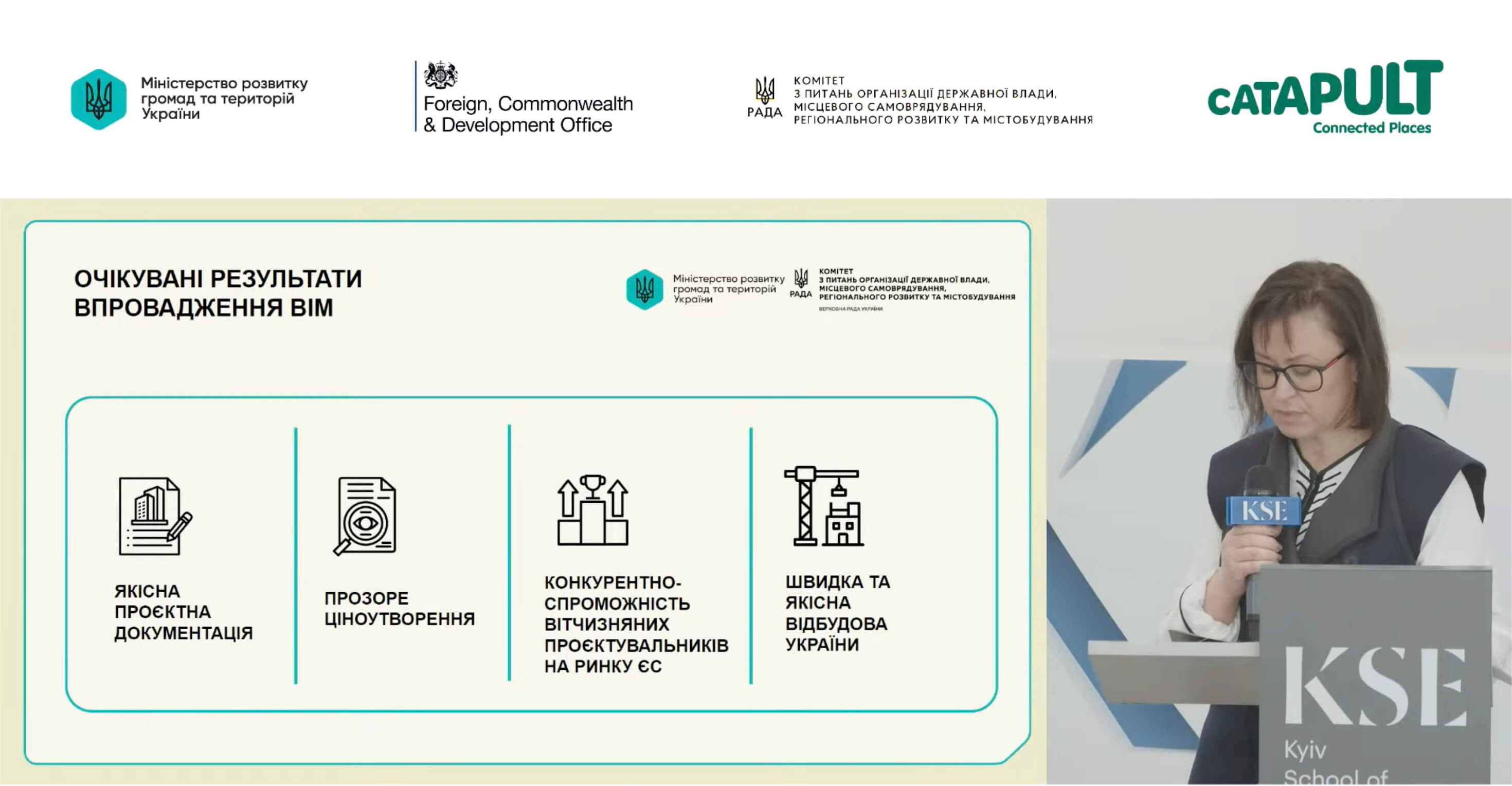
The discussion focused on draft law No. 6383 on the implementation of BIM in Ukraine. The key provisions of the draft law, market and public sector issues that the document aims to address, as well as its current parliamentary status and possible stages of implementation were discussed.
Special attention was paid to international experience, in particular the path taken by the United Kingdom, where the implementation of BIM at the level of state policy has become the standard for public construction.
The event also featured the results of a survey of architects and designers regarding the market's readiness for BIM implementation.
What market research shows
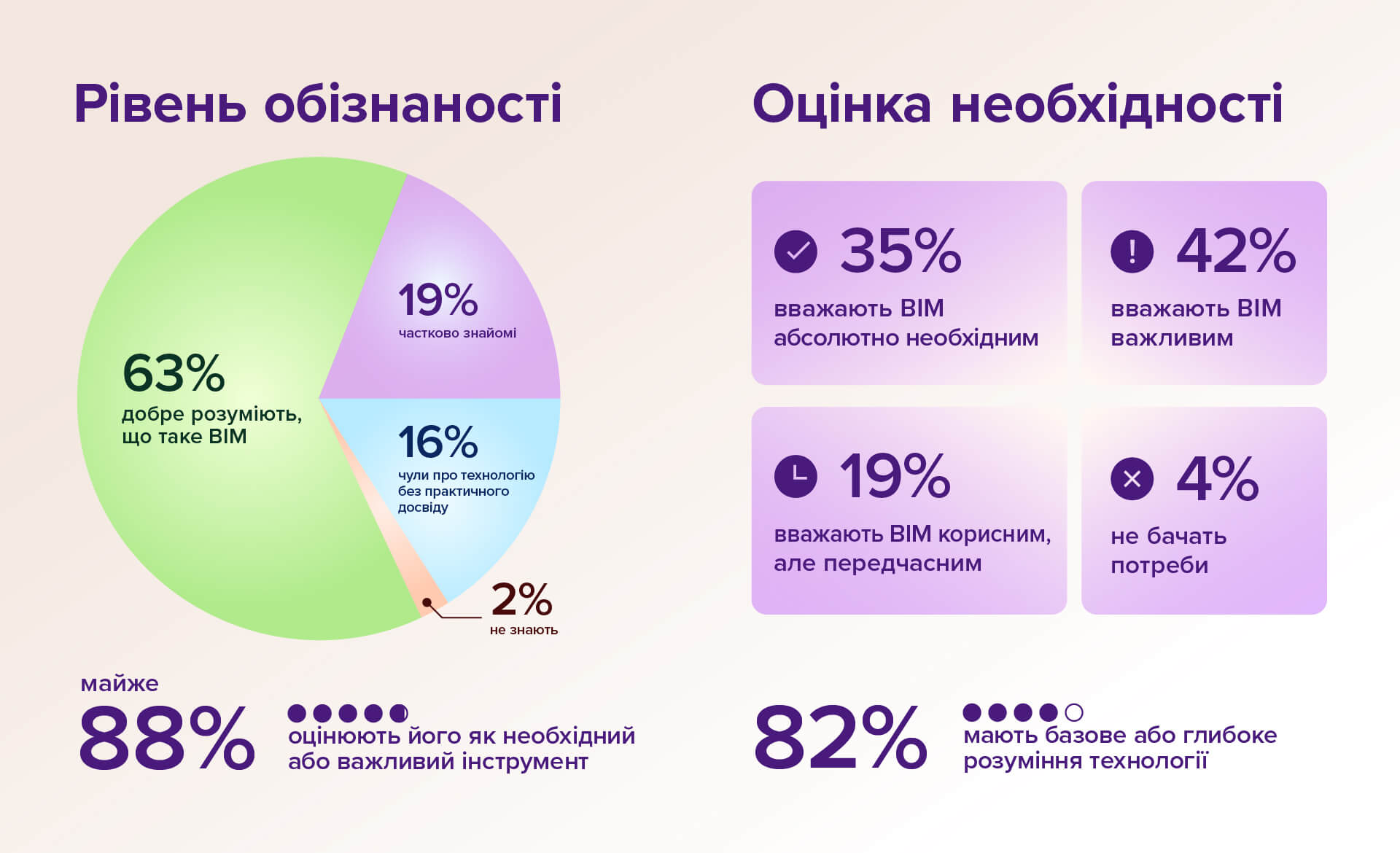
The survey covered 599 respondents from among certified architects and designers.
Level of awareness:
- 63% have a good understanding of what BIM is;
- 19% are partially familiar;
- 16% have heard of the technology but have no practical experience with it;
- 2% do not know.
Therefore, 82% have a basic or deep understanding of the technology.
Assessment of necessity:
- 35% consider BIM absolutely essential;
- 42% — important;
- 19% — useful, but premature;
- 4% see no need.
Among those who have a good understanding of BIM, nearly 88% rate it as a necessary or important tool. This demonstrates a direct correlation between awareness and support for implementation.
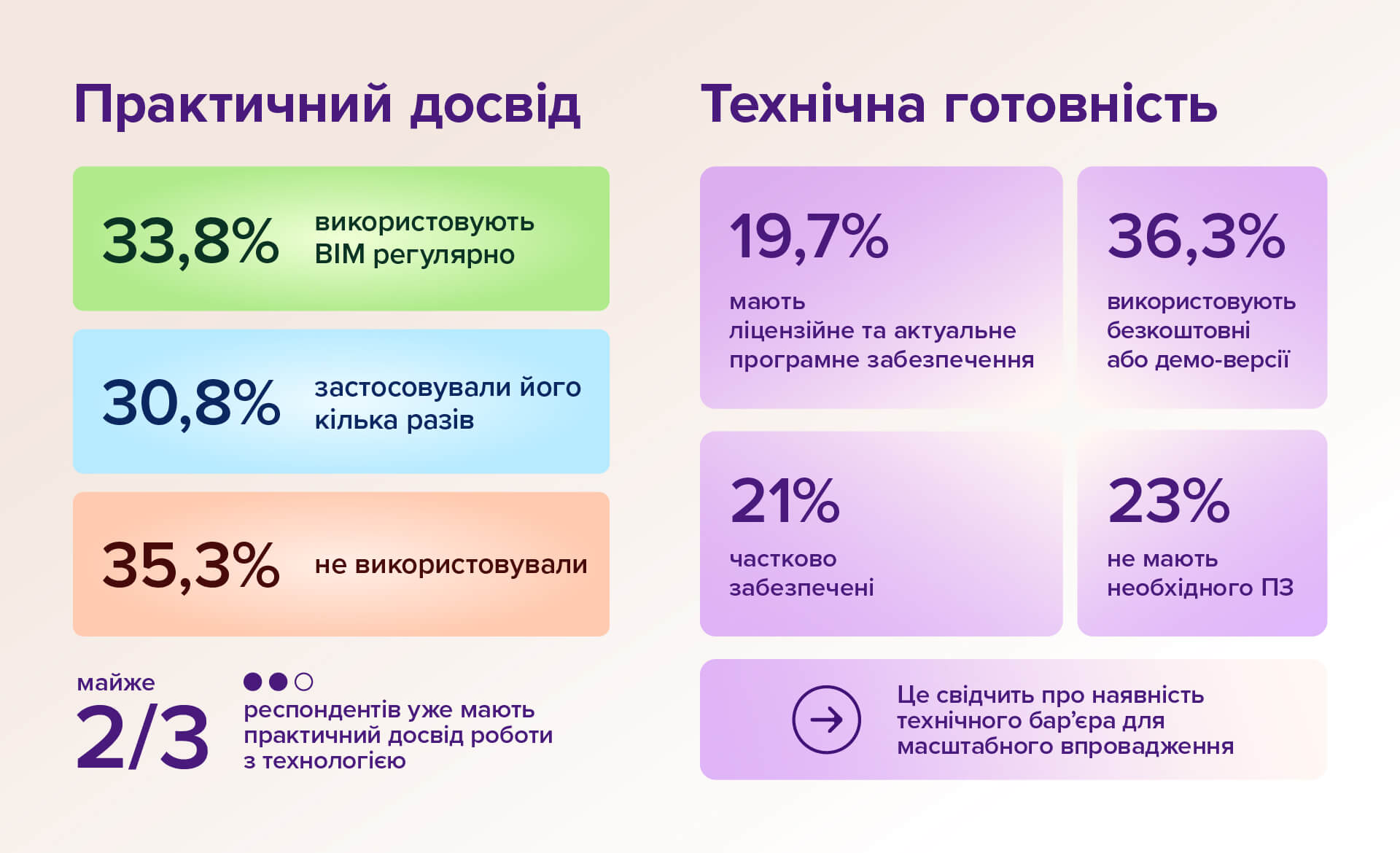
Practical experience:
- 33.8% use BIM regularly;
- 30.8% used it several times;
- 35.3% did not use it.
This means that almost two-thirds of respondents already have practical experience working with the technology.
Technical readiness:
- Only 19.7% have licensed and up-to-date software.
- 21% — partially provided for;
- 36.3% use free or demo versions;
- 23% do not have the necessary software.
This indicates the existence of a technical barrier to large-scale implementation.
Expected cost increase:
72% of respondents predict that using BIM will increase design costs by more than 10% compared to the traditional CAD approach.
The transition is perceived as an investment with a short-term price increase at the outset.
63% support the implementation of BIM in projects funded by public money.
Over 80% are ready to master the technology within three years — provided they receive adequate support.
Practice: how BIM is already working in Ukraine
In addition to theoretical discussions, there are already companies in Ukraine that systematically apply BIM in their work.
One example is the Kovalskaya Group, which implements BIM in residential, commercial, and industrial projects. In total, approximately 300,000 m² of facilities have been completed or are under construction using this technology. Five of them have already been commissioned, and four more are under construction.
.jpg)
Among the projects are the Rusanska Havanna residential complex in Kyiv, an aerated concrete plant, and office buildings B04 and B06 in the UNIT.City innovation park. These include both large-scale residential developments and complex industrial and commercial facilities with a high concentration of engineering systems.
In practical terms, the application of BIM has made it possible to:
- minimize conflicts between engineering systems at the modeling stage;
- automate the calculation of work volumes and materials;
- plan schedules more accurately;
- use digital 3D models of the work front and technical charts;
- strengthen control over implementation at the construction site.
From an economic point of view, it is important to consider the structure of a building's life cycle costs: design accounts for 1.5–3% of the total budget, while construction accounts for over 80%. It is during the construction phase that digital modeling can reduce the risk of errors, rework, and delays, which in the traditional approach lead to additional costs.
Conclusions for the market
A survey by the Ministry of Development shows that the Ukrainian professional community generally has a positive view of BIM and recognizes its potential. At the same time, there are clear challenges: technical readiness, the need for licensed software, the expected increase in design costs, and the need for staff training.
In the context of reconstruction, BIM is seen not only as a technological upgrade, but also as a tool for increasing transparency, manageability, and long-term efficiency of investments in construction.
Further development in this area will depend on the balance between regulatory decisions, market support, and the industry's real capabilities for large-scale transition.
.jpg)


