The government is driving demand, but the market lacks supply: The Ukrainian Association of Developers has released the results of a survey on barriers to residential construction
The Ukrainian Association of Developers conducted its first annual industry survey of developers regarding their views on administrative barriers in construction and presented the results during a roundtable discussion in Kyiv focused on key challenges in residential construction. During the event, participants discussed the procedures that currently pose the greatest obstacles to the launch and implementation of housing projects in Ukraine.

Participants in the discussion included Olena Shulyak, Chair of the Verkhovna Rada Committee on the Organization of State Power, Local Self-Government, Regional Development, and Urban Planning; DIA Chairman Oleksandr Novytskyi, Deputy Minister of Community and Territorial Development Nataliia Kozlovska, Deputy Minister of Economy, Environment, and Agriculture Vitalii Petruk, as well as executives and founders of leading real estate development companies. At the same time, it should be noted right away that the study included companies that account for one-third of the total supply in the primary residential construction market—over 30,000 apartments per year.
The context of the discussion on administrative procedures extends far beyond the purely sectoral level. Today, the state has effectively become one of the key drivers of housing demand in Ukraine. Significant effective demand is being generated through the “eOselya” initiative, compensation for destroyed housing, programs for military personnel, and other government programs. However, as noted by Yevhen Favorov, head of the Ukrainian Association of Developers:
“The market cannot meet demand immediately: developers build ‘to order,’ and by the time a building is completed, 80–90% of the most marketable apartments have usually already been sold. Therefore, if the government wants to secure additional housing for its programs, it will take time—at least 2–4 years, a significant portion of which is devoted to the administrative preparation of the project.”
The results of an industry survey presented by Yevhen Favorov during the event showed that administrative barriers are indeed one of the key factors slowing down the entry of new housing onto the market. According to the survey results, the average duration of administrative project preparation—from land registration to obtaining a construction permit—is approximately 14.4 months. Land rights registration takes 13.3 months, and obtaining a construction permit takes another 9.78 months.
The biggest barriers to the implementation of development projects were identified as: difficulties in obtaining urban planning conditions and restrictions (35%), difficulties in land and property relations (30%), instability of permits and their revocation (24%), difficulties in obtaining technical specifications (22%), as well as constant changes in rules, requirements, and legislation (20%).
Among the procedures that developers believe most urgently require optimization at the national level, the top priorities are cultural heritage protection (49%), cadastral and land procedures (29%), access to urban planning information (28%), and digital services and registries (26%).
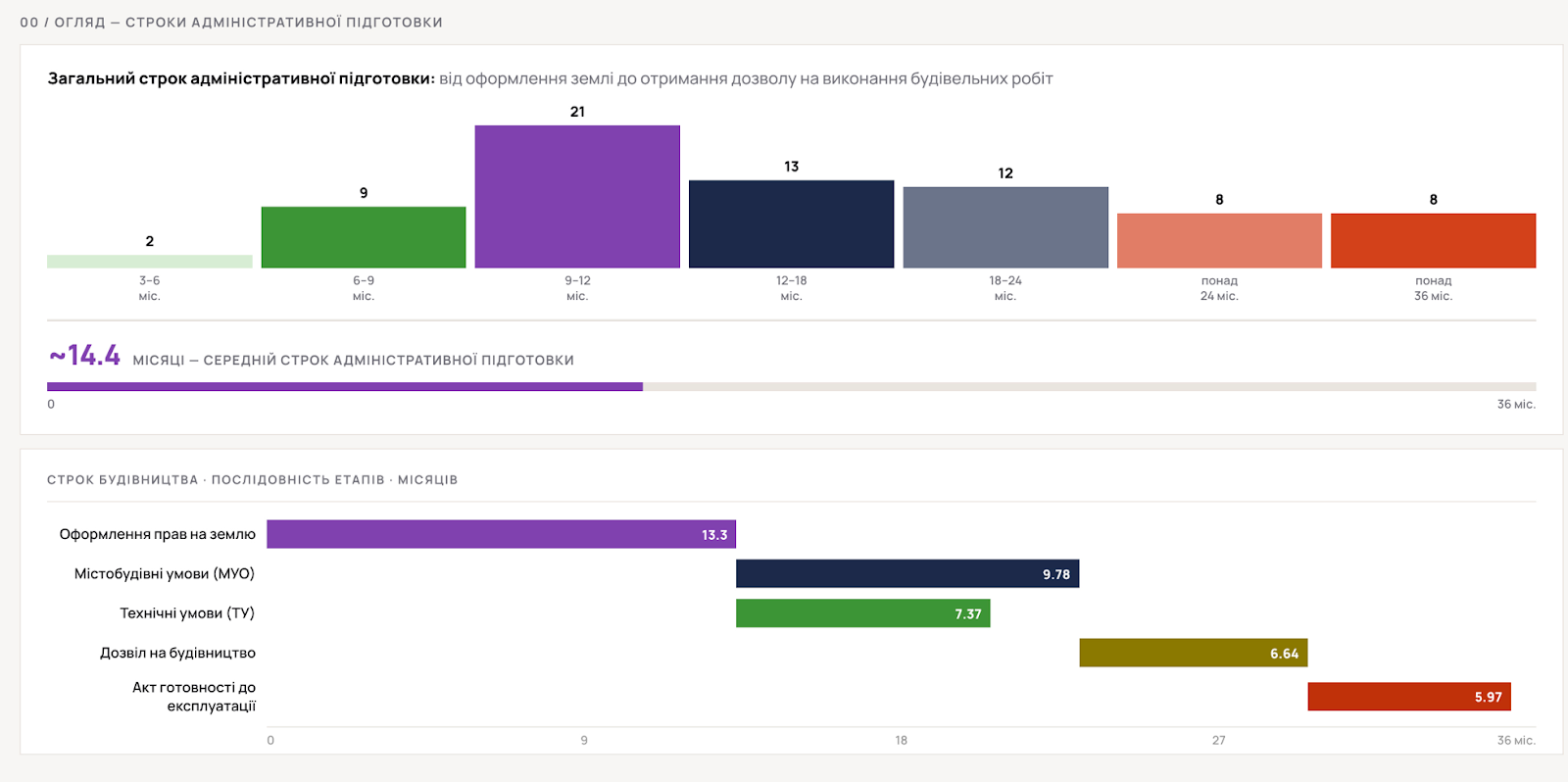
Image from the report on the results of an industry-wide online survey. Sample size: 120 respondents (owners, executives, and industry specialists at real estate development companies).
It is precisely these factors that the market currently views as having a direct impact on project completion timelines, the supply of housing, and the investment climate in the sector.

During the discussion, Olena Shulyak, chair of the relevant parliamentary committee, emphasized that the issue of urban planning conditions and restrictions runs much deeper than mere questions of administration or the speed at which documents are issued:
“MUOs have effectively become a quasi-regulatory tool that creates corruption risks, reinforces the monopoly of local authorities, and, in some cases, places developers in a dependent position.”
At the same time, she believes that a systematic solution to this problem is impossible without up-to-date urban planning documentation that has been digitized and made publicly available at the national level, so that the market has access to clear and transparent rules. Without modern urban planning documentation at the local level, it is impossible to talk about high-quality urban development planning and the implementation of housing policy.
Olena Shulyak also called for a resolution to be submitted to the government as soon as possible, one that would establish a mechanism for responding to unjustified refusals by local authorities to issue building permits and would empower the State Architectural and Urban Planning Service to act as an arbitrator in such situations.

Natalia Kozlovska, Deputy Minister of Community and Territorial Development, commenting on the debate surrounding the postponement of certain decisions regarding urban planning documentation until January 1, 2028, explained that for the government, this is not merely a matter of a deadline, but a transition to a fully-fledged digital system. According to her, the government is simultaneously uploading existing documentation from local governments into the urban planning cadastre and advancing a reform designed to ensure transparent access to source data for construction.
“For us, January 1, 2028, isn’t about the DPT. For us, it’s about keeping our digital urban planning documentation up to date,” she emphasized.
Kozlovska added that this course of action is irreversible, and that the changes should not merely address the problems of individual projects on a case-by-case basis, but rather systematically reduce barriers for the entire market.
Market representatives, for their part, confirmed that the absence or long-standing rejection of urban planning documentation has not only regulatory but also direct economic consequences: land plots are not being developed, investments are being postponed, and housing supply is not reaching the market in the necessary volume. Roundtable participants cited specific cases where, even after passing the basic stages of approval, master plans remain unvoted on for years, and land assets are effectively “frozen.”
Roman Lyoshenko, a member of the supervisory board of Intergal-Bud, emphasized that the issue of amending existing detailed territorial plans is a separate matter. If a land plot does not comply with the functional designation of the master plan and the intended development, it cannot be developed either.
“In response to the question of what is hindering development and the creation of proposals. There are three key stages: the first is the lack of a detailed urban plan; the second is lease renewal; the third is the Ministry of Culture. There are quite a large number of ‘frozen’ plots, and no one is developing them. Thus, we and our colleagues cannot create a proposal,” says Gleb Murovansky, CEO of KAN Development.
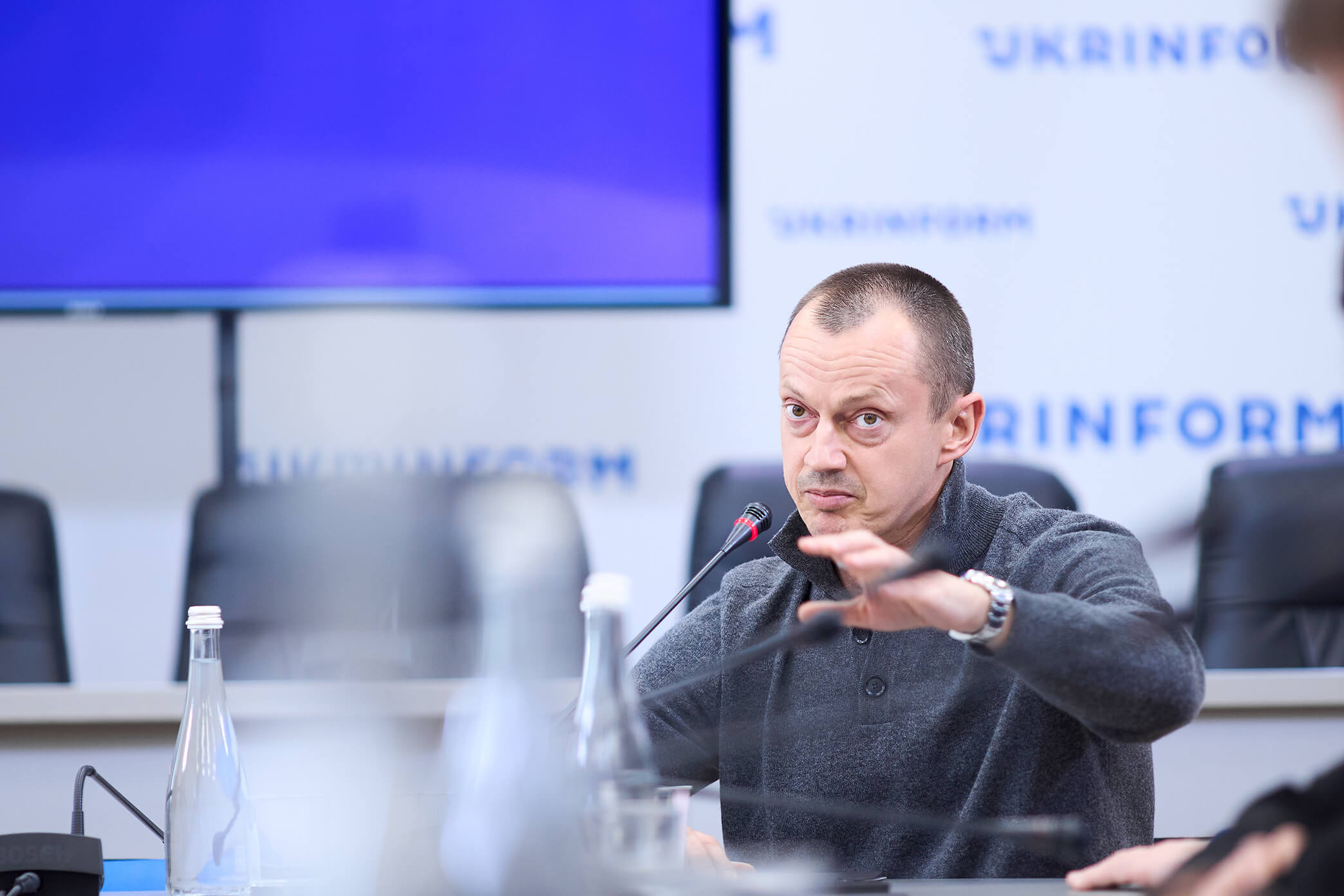
According to Rostyslav Melnyk, founder of the real estate development company RIEL, urban planning documentation—including master plans and spatial development plans—serves as the foundation for launching new projects; however, obtaining approval for them is often extremely difficult. In Melnik’s view, the key task for developers is to restore their reputation, become “positive heroes,” and unite into a powerful industry force.

Vitaliy Petruk, Deputy Minister of Economy, Environment, and Agriculture, noted that the Ministry of Economy is working in two key areas. The first is the development and expansion of financial mechanisms to support housing, particularly mortgages. The second is deregulation. He noted that the administrative issues raised by the market are already being addressed, and that the dialogue between the government and the professional community should continue in a more practical and detailed format.

Oleksandr Novytskyi, head of DIAM, emphasized that industry surveys are an important tool for identifying real market barriers that need to be discussed openly. This is because these barriers hinder the development of the industry, the economy, and the country as a whole. He also highlighted digitalization. According to him, a systematic solution to the problem of urban planning is impossible without open and digitized urban planning documentation, and the set of technical specifications and network connections requires separate reengineering—with a transition to a unified digital process and a “single window” for the client.
“In Europe, the United States, and other civilized countries, urban planning documentation is simply a set of publicly available data for construction, not restricted information kept in the safe of the chief architect or a city official,” he emphasized.
The key takeaway from the meeting is that the market now has enough data to move beyond general complaints and focus on a concrete agenda for change. Administrative barriers in residential construction are a factor that directly affects the volume of new housing, project completion timelines, the affordability of apartments for citizens, and investors’ willingness to invest in Ukraine.
The following steps, which were identified during the roundtable discussion:
- continue working together to resolve issues with problematic procedures;
- identify the specific barriers and forward the list to the relevant government agencies;
- initiate a separate meeting regarding pressure exerted by law enforcement and regulatory agencies on businesses;
- join the ongoing discussion on changes to government housing programs and financial instruments for the sector;
- continue the dialogue on the digitization of procedures and the openness of urban planning data as a fundamental prerequisite for transparent market rules.
The Ukrainian Association of Developers emphasizes that establishing predictable, transparent, and uniform rules is an essential prerequisite for the development of residential construction, increasing the housing supply, and fostering a robust investment market in Ukraine.
The development of housing construction is of strategic importance to the country. This is not merely a matter of the economy, regulatory policy, or business conditions; above all, it is a matter of people’s quality of life, the renewal of the aging housing stock, and the creation of conditions under which more Ukrainian families will be able to realistically afford their own homes, including through special government support programs.
The survey results will serve as the basis for the Association’s future advocacy efforts in collaboration with the government and the professional community.


