What Will Happen to the Housing Market in 2027: Forecasts by Igor Nikonov and Rostislav Melnik
Members of the Ukrainian Association of Developers, Ihor Nikonov (founder of KAN Development) and Rostyslav Melnyk (founder of RIEL), participated in the fifth major online conference, “What Will Happen to Ukrainian Real Estate Prices in 2027,” as part of Ukraine Economic Outlook. During the discussions, they addressed sales trends, rising construction costs, shifts in demand, labor shortages, financing, and market prospects after the war ends.

Demand for new construction is changing
Igor Nikonov reported that in the first half of 2026, KAN Development's sales growth improved significantly compared to the same period the previous year: the corresponding figure rose from approximately 13% to 38%.
According to him, what matters to a developer is not only the number of apartments sold, but also the pace of sales. The longer a project takes to sell, the greater the strain on its financial model.
The structure of demand is also changing. The percentage of KAN Development’s clients who purchase real estate as an investment asset has risen from approximately 10% to 25% over this period.
“This came as something of a surprise to me: the share of investment purchases rose from about 10% to 25% over the course of a year. In other words, more and more people are investing in real estate,” said Igor Nikonov.
Buyers have begun to pay special attention to parking facilities. While demand for parking spaces was previously low, during a full-scale war, underground parking has become not only a place to park a car but also an additional indicator of safety.
“Sales of parking spaces have risen sharply, as people view underground parking garages as a form of shelter. Whereas in the past we could sell parking spaces for another three or four years after a project was completed, we’re now seeing a shortage of them,” said Igor Nikonov.
Construction costs are rising faster than housing prices
Rostislav Melnyk presented an analysis of changes in the cost of construction materials and labor in Kyiv and Lviv.
According to his data, from the third quarter of 2025 to the same period in 2026, the cost of concrete in Kyiv rose by approximately 69%, ceramic bricks by 68%, and ceramic blocks by 27%.
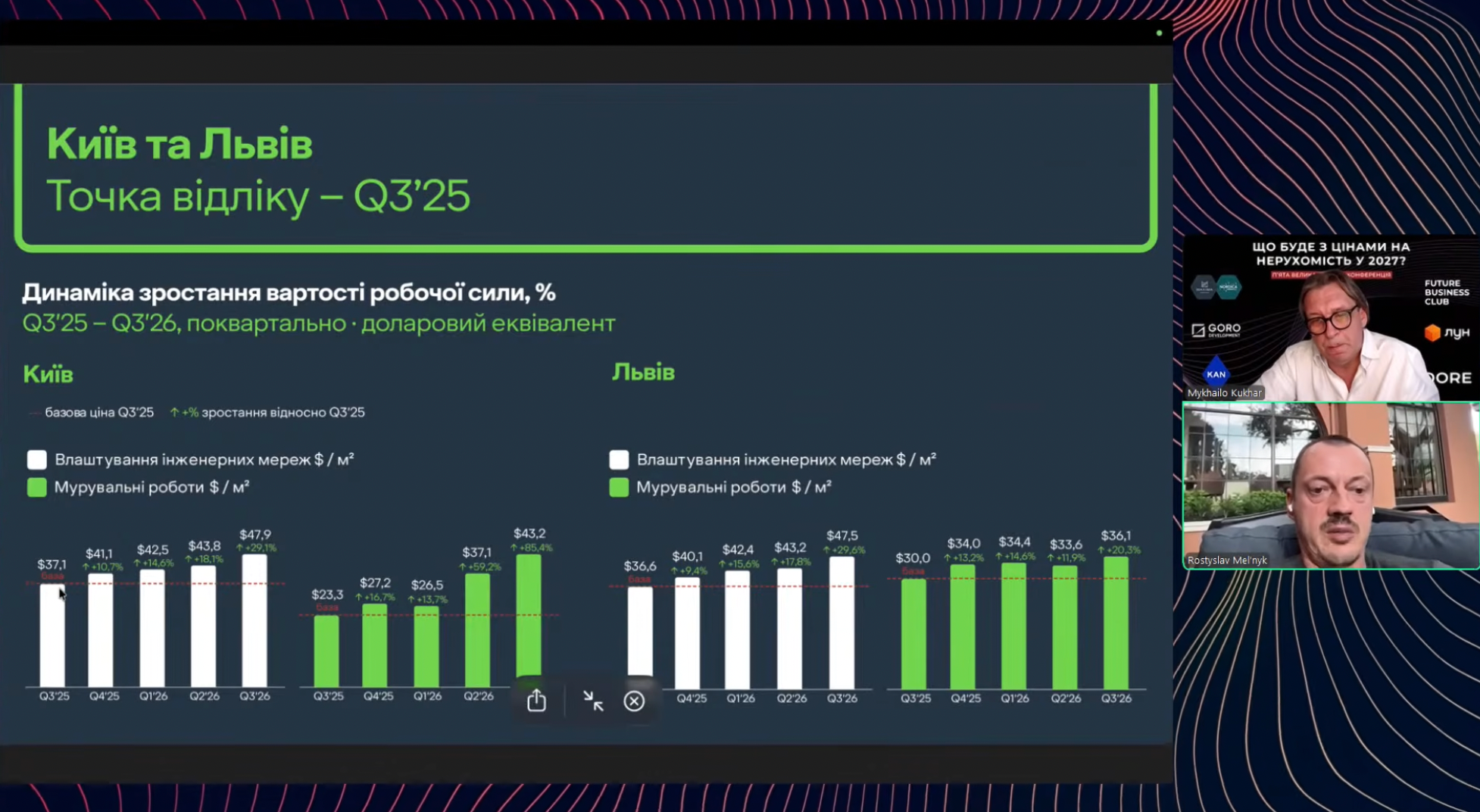
The cost of certain types of construction work has risen even more sharply. In particular, the cost of bricklayers' labor in Kyiv has increased by approximately 85% over the past year, while that of utility system specialists has risen by 29%.
As a result, the cost of the group’s individual projects increased by 16.6–30%, depending on the city and the stage of completion of the project.
“The past year has seen the largest increase in production costs in all the years we’ve been in the market. This poses a major threat to developers,” emphasized Rostislav Melnyk.
Prices for completed housing are rising much more slowly, so developers are currently covering part of the additional costs by drawing on their own profit margins. However, it will be difficult to keep prices stable for long given the rising cost of construction.
“Production costs are rising. We (KAN Development) are gradually raising our prices, but this is the market: you can’t just set a higher price and wait for a buyer to come along. That’s why our margin has shrunk significantly,” said Igor Nikonov.
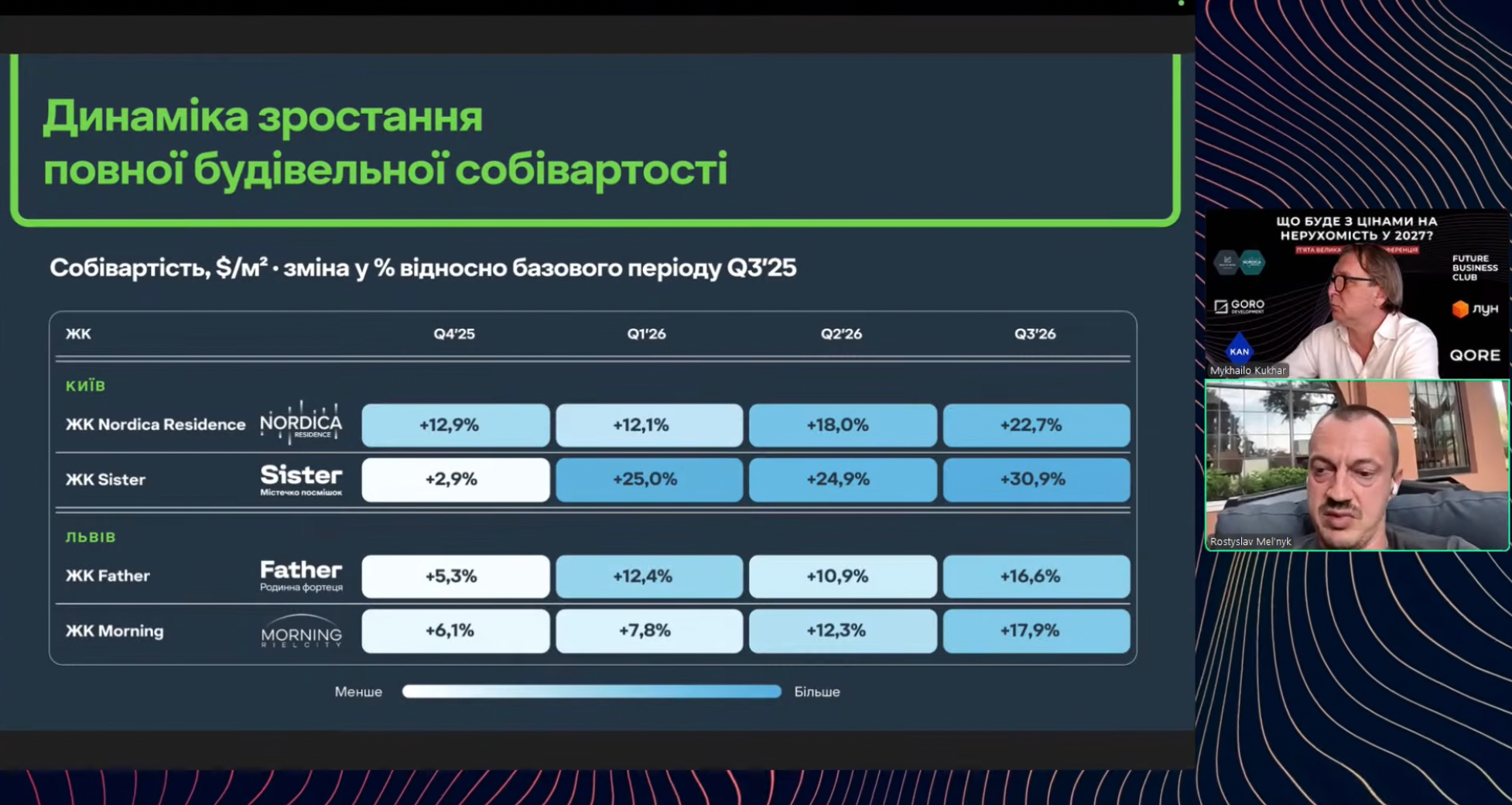
According to Rostyslav Melnyk’s assessment, even if construction costs rise not by 20% but by approximately 15% in 2027, this will inevitably affect the final price of housing. Therefore, 2026 may be one of the last years when buyers still have the opportunity to lock in a relatively lower price.
Deferred payments are becoming increasingly difficult for developers
Financing a home purchase remains a particular challenge. In the economy and comfort-class segments, buyers are often unable to pay the full cost of an apartment at once and opt for installment plans.
Under this model, the developer effectively extends credit to the buyer and must finance part of the construction out of its own pocket. Against the backdrop of rapidly rising construction costs, this is becoming increasingly difficult.
The “eOselya” program is having a positive impact on the market . When an apartment is sold under the mortgage program, the developer immediately receives the full amount, which reduces financial risks. According to Rostyslav Melnyk, “eOselya” currently accounts for 10% to 15% of the company’s sales.
At the same time, a single program is not enough for the market to develop fully—other long-term financing instruments are also needed.
“My opinion is that our current market and our business model are transitional. This situation cannot last very long. There needs to be a mortgage program or other tools that will actually enable people to buy on an installment plan,” says Rostislav Melnyk.
Reconstruction will require more than just funding
Rostyslav Melnyk emphasized that even with international funding, the pace of postwar reconstruction could be limited by shortages of workers, materials, and equipment, as well as lengthy regulatory procedures.
The labor shortage is already affecting construction costs and timelines. According to Melnik, his company still has dozens of unfilled positions, and salaries are rising across all categories—from blue-collar workers to office professionals:
"There is currently a severe shortage of all types of professionals. When it comes to the rate of salary growth for office workers, financiers, accountants, and lawyers—it has also been phenomenal over the past three years."
The return of Ukrainians from abroad after the war ends may partially improve the situation. However, if a large number of new projects are launched at the same time, developers will compete for limited resources and workers, which will lead to a further increase in construction costs.


