Discussion on Bank Financing for Construction at the First Mortgage Forum
On March 31, Kyiv hosted the First Affordable Mortgage Forum —a professional forum dedicated to discussing the development of the mortgage market, housing policy, and affordable housing in Ukraine. One of the forum’s key discussions was the panel “Are Banks Ready to Lend to Developers?”, which featured representatives from the banking sector, the insurance market, and development companies, including Yevhen Favorov, Chairman of the Ukrainian Association of Developers.

During the discussion, participants agreed that the issue of development financing today is not limited to the cost of capital or banks’ risk appetite. It involves a much broader set of factors: war risks, capital requirements for banks, the absence of a comprehensive project financing model in legislation, as well as instability in the regulatory environment, which directly affects developers.
In his speech, Yevhen Favorov emphasized that, in essence, the discussion has hardly changed over the past year. Ukrainian banks remain unwilling to fully finance developers, and the developers themselves are unwilling to take on such obligations under current conditions. At the same time, this does not mean that the market does not need this instrument—quite the contrary. However, it must emerge as a real and effective option that operates under clear rules.
“Just as a year ago banks were unwilling to lend and developers were unwilling to take out these loans, the situation today has not fundamentally changed. But we want developers to have an optional project financing tool—one that is straightforward, practical, and can actually be applied at any stage of the project,” noted Yevgeny Favorov.
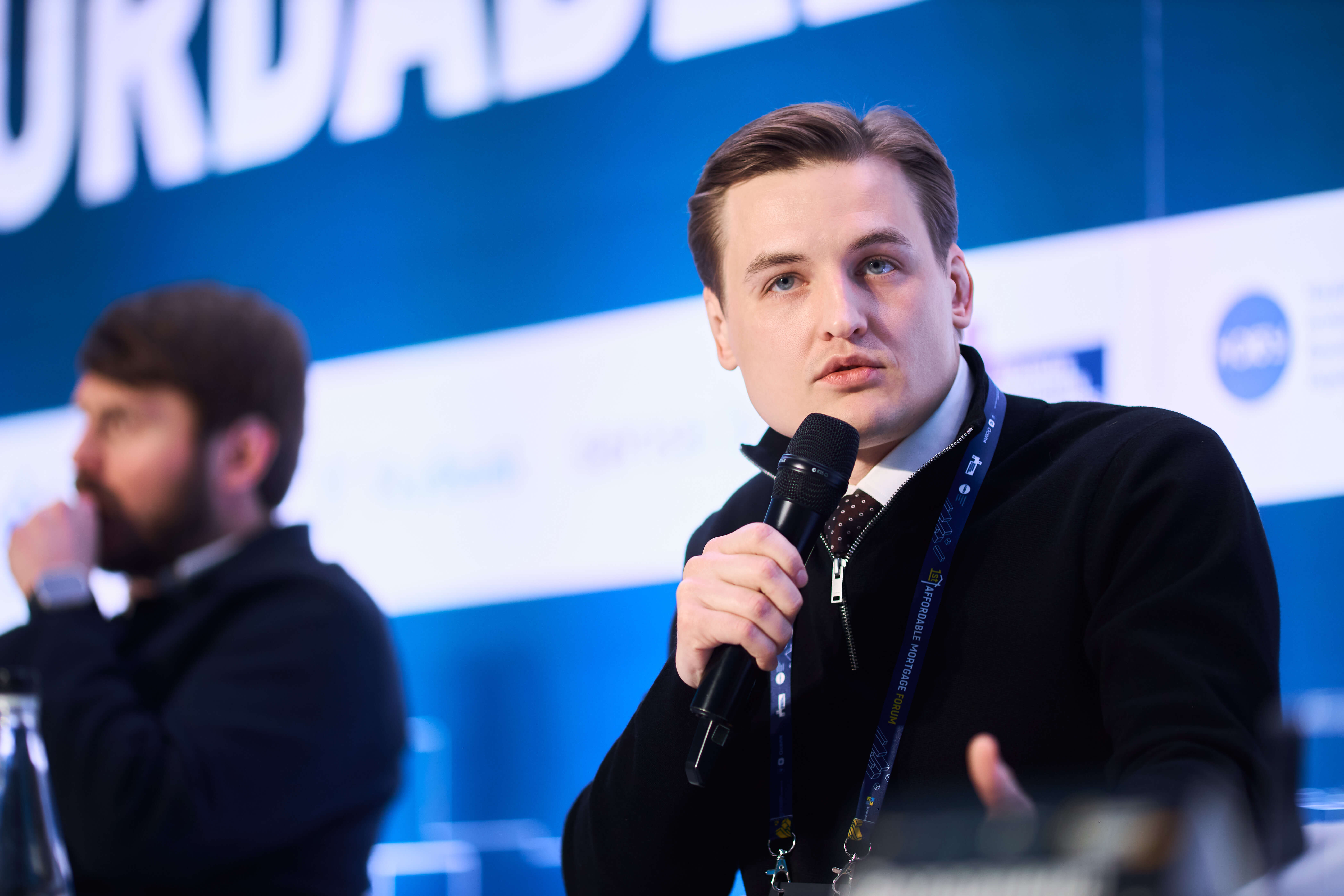
He specifically highlighted a key obstacle that is currently holding back both banks and developers: the instability of permitting and urban planning documentation. According to him, the problem is not limited to building permits alone. The entire chain of documents underpinning the project’s implementation could be at risk.
“What happens if your permit is revoked? But we understand that a permit is just the final document. The urban planning documentation could be revoked, the urban planning conditions and restrictions could be revoked, and the right to lease the land plot could be terminated. And that’s a major problem, both for the developer and for the banks,” he added.
As an example of a more predictable environment, Yevhen Favorov cited the Polish practice, where, once a specified period has expired, a building permit cannot be revoked through administrative channels. It is precisely this predictability, in his view, that creates a normal economic environment and makes long-term financial instruments possible. According to him, the Association has already commissioned a separate legal study to determine exactly what regulatory obstacles are currently preventing banks from lending to developers, and after consulting with banks and Ukrfinzhytlo, it will present a joint vision for solutions.
“Generally speaking, the term ‘project financing’ does not currently appear in legislation. We have commissioned a major legal study to analyze exactly what is preventing banks from lending to developers, and after consulting with the banks and Ukrfinzhytlo, we will present a joint position that will help unblock this lending.”

During the discussion, particular attention was paid to the very model of financing housing projects that has historically developed in Ukraine. Roman Davymuka, CEO of Avalon, noted that today developers often raise funds not through banking instruments, but effectively directly from buyers, and that this has become a standard sales model in Ukraine:
“In one of its reports, the international organization IFC referred to the Ukrainian primary real estate market as a ‘market for developer microloans.’ In other words, the way we operate now, we are essentially taking interest-free loans from the general public. And in reality, in this case, the bank—as a means of raising funds for a project—is competing with the average Ukrainian.”
At the same time, the developers on the panel clearly outlined the practical aspects of the issue. Ivan Molchanov, co-owner of Stolitsa Group, spoke about securing financing from the EBRD for residential real estate—a case he described as the first of its kind in Ukraine.

According to him, the company was able to follow this path thanks to the transparency of its internal processes and a clear business structure. At the same time, he emphasized that this is not about giving up the company’s own liquidity, but rather about a tool that enables projects to be implemented more quickly:
“The era of property builders is over, and the era of developers is in full swing. Until now, we’ve relied entirely on our own liquidity, but we’ve decided to try raising capital as a way to accelerate construction even further.”
Molchanov also noted that international financial institutions are often more flexible than Ukrainian banks—in their approach to collateral, in their assessment of the group of companies as a whole, and in the cost of funding. Separately, he gave a positive assessment of the “eOselya” program’s impact on housing sales and emphasized that it can be scaled up and further improved.

Olena Ryzhova, Commercial Director of “Intergal-Bud,” also confirmed that demand for mortgages in the market is very high. At the same time, in practice, a significant portion of clients cannot take advantage of the current programs—either due to formal restrictions or because of the new parameters of the “eOselya” program, which have narrowed the range of available properties. In such cases, developers are forced to compensate for the market’s shortcomings with long repayment terms:
“There is high demand for ‘eOselya.’ However, not all customers qualify for it, so developers are effectively forced to offer an alternative: long-term installment plans. There is a need in the market and huge demand for mortgages, but currently there are not enough tools to meet that demand.”
Another key point Ryzhova emphasizes is the quality of the relationship between the bank and the developer. According to her, successful mortgage lending in the primary market is possible only where there is not only formal accreditation of the property but also effective communication between the teams on both sides.
Representatives of the banking and insurance communities, for their part, outlined the constraints facing the financial sector. Serhiy Avdeev, Chairman of the Board of Arsenal Insurance, stated outright that there is no insurance product on the commercial market that would cover the risk of construction not being completed, and likely never will be, since these are speculative financial risks that commercial insurance companies cannot assume. However, the market does provide insurance for property and war risks for properties within the “eOselya” program.

Serhiy Mamedov, Chairman of the Board of Globus Bank, noted that the bank is already effectively involved in real estate development through mortgage and commercial programs for homebuyers; however, it does not provide separate investment loans for development projects due to its specific focus and capital requirements. At the same time, he emphasized that transparent financial reporting, a clear ownership structure, a track record of completed projects, and trust in the developer are fundamental prerequisites for any financing.

Volodymyr Chornenkyi, head of the NABU Mortgage Committee, noted that Ukraine’s banking system is liquid, but the domestic mortgage market is held back primarily by high interest rates and unresolved issues regarding the protection of creditors’ rights. Regarding project financing, he acknowledged that this product should be available on the market, but launching it requires significant collaboration among banks, developers, legislative and executive authorities, as well as the regulator.
It is telling that the discussion went far beyond the question of “whether banks are ready.” In fact, the panelists spoke about the need for a new model of interaction, in which project financing, mortgages, buyer protection, and stable rules of the game operate not in isolation, but as a unified system.
This is precisely what the Ukrainian Association of Developers consistently emphasizes in its work. The market needs not piecemeal solutions, but a predictable regulatory framework that will pave the way for more affordable housing, increased construction volumes, and clear guidelines for all participants. In short, the development market needs clear, stable, and transparent rules of the game.
Summing up the discussion, Yevhen Favorov emphasized that while there is potential for growth, it can only be realized if the market, banks, and the government work together to develop systemic solutions:
“I’m sure it’s up to us. If we work hard, we’ll grow. If we fall behind, we won’t.”


